Project Overview
The Yamuna River Project (YRP) is a multidisciplinary research initiative, established by Iñaki Alday and Pankaj Vir Gupta, with design research studios co-taught over the past decade with María Gonzáles Aranguren (University of Virginia), Andrea Bardón de Tena (Tulane), Monisha Nasa (Tulane), and Jess Vanecek (Tulane). Through interdisciplinary research and teaching, the project has sought to develop and advance strategies for the ecological recovery of one of the most polluted rivers on the planet – the Yamuna, in the megacity of New Delhi, India, the capital of the largest democracy in the world. The pollution of the river has become an unprecedented and urgent crisis of ecological inequality and a serious threat of the health of the entire population. That said, the river itself is not the problem, so much as it is the symptom of broader social challenges. It can only be reversed by sustained remedial action, encompassing all the complex components of the city: social, cultural, health, economics, ecology, public space, public facilities, housing, governance, and infrastructures.
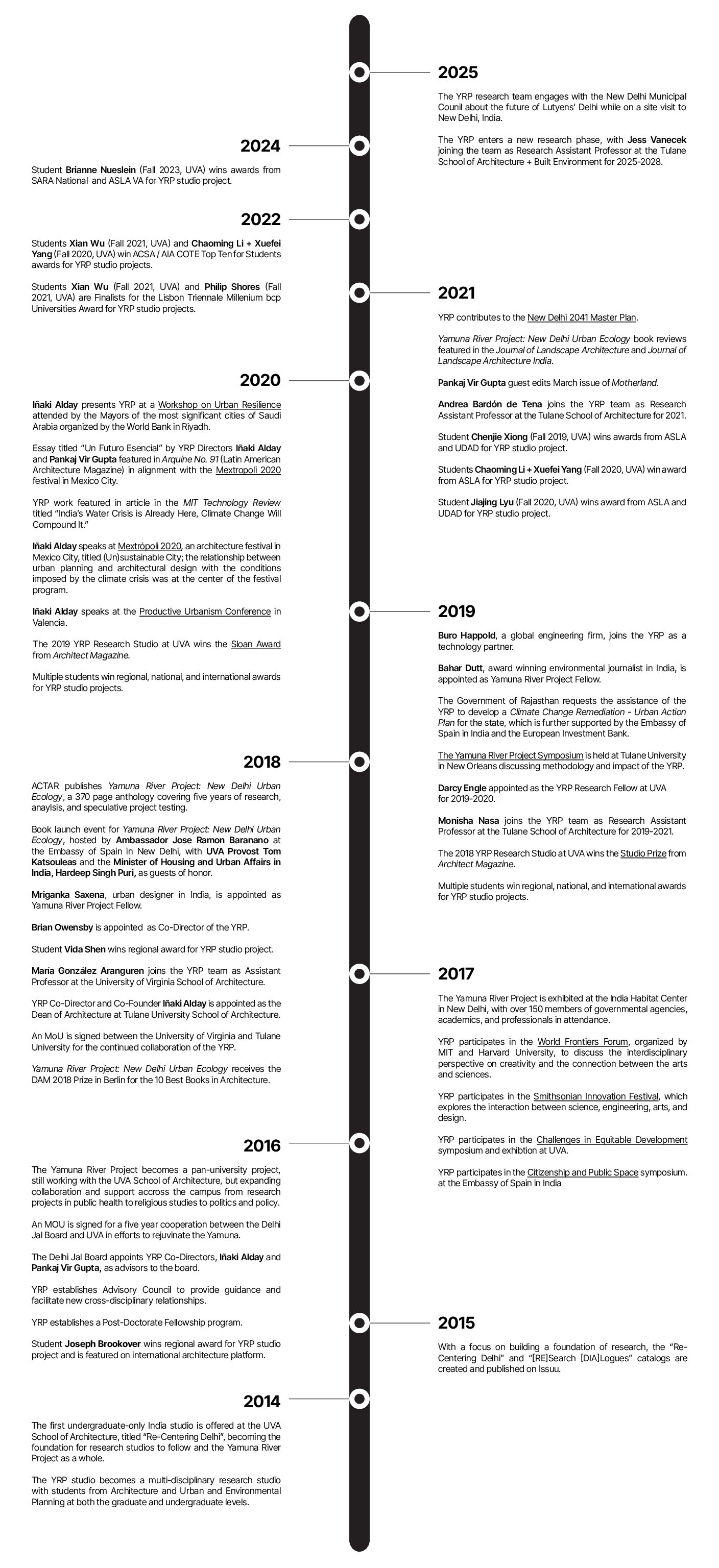
Since inception in 2013, the project has engaged a network of domain experts, both in the United States and in India. These mentors and experts contribute research from their own arenas of investigation, enriching the design foundations for the YRP students. A critical component of the methodology is the idea of accountability, in internal discussions but also in external exposure. The interaction with local agencies and politicians, and a regular outreach in the form of exhibitions and publication of the studio work, is part, not only of an advocacy strategy but also an idea of service to underserved urban communities.
New Delhi Urban Ecologies encompasses phases of the project from 2013-2018 and 2021-2023, primarily based at the University of Virginia, during which research was focused on the relationship between Delhi’s urbanization and the Yamuna River. Sites of inquiry spanned throughout the Delhi National Capital Territory (NCT) — from the center where the seat of power lives, to its northern and northwestern edges where the Yamuna first enters the city, to its south-eastern edges where the her now toxic waters flow out of the city. A significant portion of the work from this phase was published in Yamuna River Project: New Delhi Urban Ecology by Iñaki Alday and Pankaj Vir Gupta in 2018.
Jaipur Thirsty Cities marks a phase of the YRP from 2019 to 2022, during which teams from the University of Virginia School of Architecture and the Tulane School of Architecture and Built Environment jointly examined the city of Jaipur, Rajasthan with a multidisciplinary approach centered around water scarcity. Besides urban morphology and architecture, the understanding of the city included socioeconomics, ecology, history, infrastructures, and all layers that constructs the complexity of the urban life. Students from both universities worked in parallel design studios conducting research, fieldwork in Jaipur, and speculative proposals.
New Delhi Urban Futures represents the start of a new and ongoing research trajectory for the Yamuna River Project based at the Tulane School of Architecture and Built Environment, beginning in 2025. Building upon early work of the YRP that foregrounded the recovery of the Yamuna River and her degraded tributaries, canals, and drains, the project now centers around an evolving research agenda that positions the degradation of air, water, and environment as indicators of systemic failures due to a century’s worth of negligent urban evolution. The focus shifts away from the river’s edges to the historically planned fabric of New Delhi’s urban core – one that was designed for performance under very particular economic conditions and societal aspirations, but that now confronts radically different circumstances, resulting in multiple levels of dysfunction due to unplanned population growth, fragmented policy measures, and stressed infrastructural systems.
2
ACADEMIC INSTITUIONS
12
YEARS OF RESEARCH
15
FUNDED RESEARCHERS
11
RESEARCH TRIPS TO INDIA
200+
STUDENTS ENGAGED
80+
FACULTY ENGAGED